New Website, Same Team. All Coffee

Search

Search for a coffee, machine or brand.

History

152 High Street, 1996

Guy Griffith-Jones grew up in Wellington and spent a number of years cooking for the crew on fishing boats, saving for something of his own. With an interest in coffee, he moved to Christchurch with his school friend Dion Paxie to open a late-night café at 152 High Street, pouring coffee late into the night.

They called it C1. The name didn’t mean anything yet, which was the point: it could grow an identity of its own. Its likeliest inspiration was C1000, the canvas Cactus chose for clothing and outdoor gear made to last a lifetime and outlast the rest. Gwilym Griffith-Jones drew the logo.

Thirty years on, the name has lasted too.

C1 Espresso's tables on High Street
C1 Espresso on High Street.

Along High Street, the Hurst and Drake department store was being demolished, where the Ara building stands now. We asked the crew if we could take some of it, and built C1’s counter and tables from its MDF.

The first espresso machine came from a second-hand shop up Manchester Street: a two-group lever machine with a joker on the back, for $1,200. It had no pump, so the water had to be filled by hand, and often: a dangerous and horrible way to run a café. Within a few weeks it was gone. David from Burton and Hollis lent us a La Cimbali, which C1 later bought, and knew of a café closing in Blenheim, where we found fridges and a food mixer. Jason turned up a few weeks before opening, helped with the plumbing and cut new inserts for old light fittings to give the place its own look. Jeff Edwards, a collector of all things who had started the Chocolate Bomb on Manchester Street, helped with paint, and gave a novice plenty of friendly advice on everything from labour rates up.

Most of C1 was salvaged, borrowed or given.

Building C1's interior in 1996
Building C1, 1996.
Early days at C4
The build crew, 1996.

152 High Street, 1996–1999

Ben Kepes was part of it from the start. He knew Guy through Cactus, which Gwilym, Rob and Ben had started in Wellington and moved to Christchurch a couple of years earlier, and Cactus took a 25% share in C1.

The coffee came from Havana. Guy had known Geoff Marsland since growing up in Wellington, and Ben had been at school with Geoff and Tim Rose, so before the move Guy walked into Havana, said he was off to Christchurch, and asked them to supply the new café.

Cafés were still new and niche, and there was a lot to learn. Plenty of cafés and restaurants served bad coffee then; C1’s whole idea was to focus on the coffee. For its first year C1 was 120 square metres. A year later it took over two thirds of the bike shop next door, with Graham from Eco Frame in the other third, and the café doubled.

A C1 Espresso stamp card
C1’s stamp card: ten coffees for the T-shirt.
A postcard from Havana
A postcard from Havana.

Dunedin, 1999

David at Burton and Hollis heard of a roaster for sale in Dunedin. An American couple, part of another Dunedin roastery, had a 12 kg Probat installed in the shed on their farm, and had decided to move back to the States. It cost $50,000.

Jason Tweede lent Guy his truck, and Guy and Paula drove south to put a small blue roaster on the back. When they arrived they were told a tale, possibly true, about alien abductions. Whether it was why the couple were going home, we never found out.

C4 had its first roaster.

Poplar Lane, 1999–2003

Round the corner from C1, on Poplar Lane, C4 began roasting. Jeff Kennedy, Tony and Paul at L’affare in Wellington looked after us with green coffee and machinery: Rocket machines for home espresso, and the Wega that was our café machine before the Slayer.

Poplar Lane, Christchurch
Poplar Lane, where C4 began roasting.

Christchurch, 1999

The city was growing, and there were few local roasters to choose from. Almost as soon as the roaster arrived, we had our first wholesale customers: cafés, restaurants and others who wanted coffee roasted here.

At C1, people kept asking to buy the coffee to brew at home.

Poplar Lane, 1999

So that same year, C4 went online. Sales were slow at first, and orders came through a form, from customers who had already signed up and shared their payment details with us. Card payments were still a few years away.

C4's early website with its quick order form
Our website, as the Internet Archive saved it in 2000.

152 High Street, 2003

C1 was sold: the café and the roastery went their separate ways, and C4 kept the roasting.

C1 lives on. It has been with new owners since 2021, and C4 no longer has any connection to it, not even the coffee. But it is still a Christchurch institution, with something of the spirit the first team brought to it in 1996.

Poplar Lane, 2006

The 12 kg was running constantly, and we knew we would soon be moving from Poplar Lane to a much bigger site on Lichfield Street. So we bought a Probat UG22, reconditioned in Germany after spending most of its life in France, and had it shipped to New Zealand.

It was built in the early 1960s at Probat’s works in Emmerich, which Allied bombers had destroyed in 1944 and which was casting again by 1949. Its drum and frame are solid cast iron, and all that iron holds its heat.

It roasted for us until the 70 kg Loring arrived. About a year later it went to Heartland Brew (Coffee Worx).

Bagging coffee beside the roaster on Lichfield Street
The roastery on Lichfield Street.

165 Lichfield Street, 2007

In November 2007 C4 moved into a home of its own: the John Burns building, three storeys of charcoal grey on Lichfield Street, with JOHN BURNS & CO in raised silver letters above six black awnings. The roastery and café shared the ground floor, behind a COFFEE sign and the C4 oval over the door, with Cactus upstairs.

In 2009 Heath at Supreme in Australia found us a three-group Slayer, as there was no agent for it here yet, and we installed it on Lichfield Street. The September 2010 earthquake ended our time in the building.

The John Burns building on Lichfield Street
The John Burns building, C4 on the ground floor.
The Slayer espresso machine on Lichfield Street
The Slayer on Lichfield Street.
The John Burns building fenced off after the earthquakes
The John Burns building after the earthquakes.

The same year we began buying tea, drinking chocolate and green coffee in partnership with Steve and Julie Gianoutsos at Mojo.

278 Tuam Street, 2011

With the central city closed after the earthquakes, C4 opened again on Tuam Street, trading from the edge of the Red Zone while the city around it was rebuilt. The Slayer came with us, and was our main machine the whole time we were there.

The C4 sign going up on Tuam Street
The C4 sign going up on Tuam Street, 2011.
Fitting out the café on Tuam Street
Fitting out Tuam Street, 2011.
The café on Tuam Street
The café on Tuam Street, 2016.

Guatemala and Nicaragua, 2013

Our first trip to where our coffee is grown: Guy travelled to Guatemala and Nicaragua with Trade Aid.

Ethiopia and Kenya, 2015

Paula and Guy went to Ethiopia and Kenya, travelling with Justin Purser and Ewan Cameron of Trade Aid.

278 Tuam Street, 2015

In 2015 we moved on from the classic C4 logo Gwilym had drawn, and worked with Jono Ross and the team at Deflux on a new one.

Tim helped create most of C4’s voice and tone. We have written that way since the 2010s, and still do.

Colombia and Peru, 2016

Guy took members of the roastery team to Colombia and Peru.

Adelaide, 2017

Early in 2017 we travelled to Adelaide to see a Loring at work, and came home having bought a 15 kg Loring, one of the first in New Zealand. It replaced the 12 kg Probat.

113 Fitzgerald Avenue, 2020

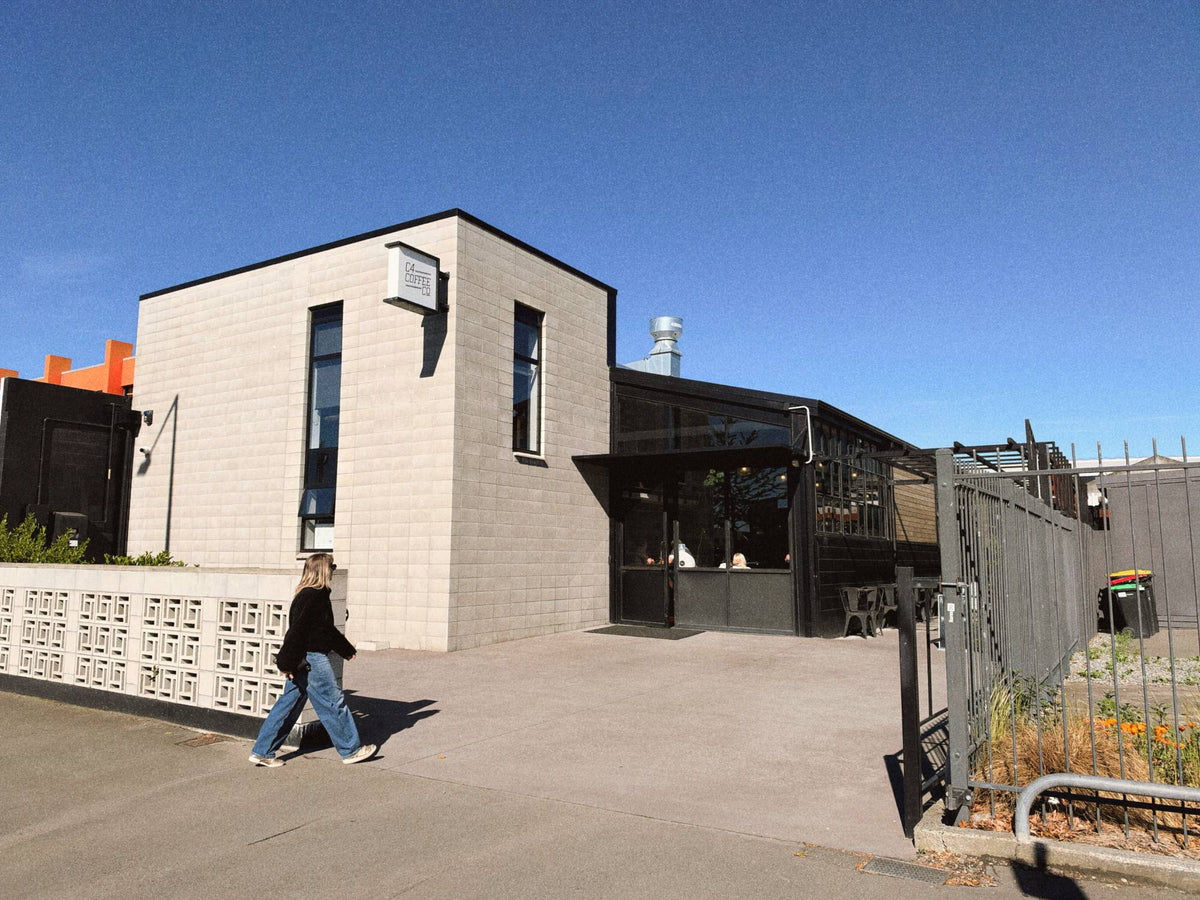
2020 brought Covid-19, and a new home: a 1970s concrete-block workshop on Fitzgerald Avenue, once Fitzgerald Autobody's panel and paint shop, with a roastery space Guy designed for the purpose. Today the roastery, café, brew bar, shop and dispatch all sit under one roof.

C4 HQ on Fitzgerald Avenue, Ōtautahi
C4 HQ on Fitzgerald Avenue.
The café at C4 HQ on Fitzgerald Avenue
The café at C4 HQ.
Coffee dispensers in the shop at C4 HQ
The shop at C4 HQ.

The South Island, 2020

The same year our coffee went into supermarkets across the South Island, bringing fresher, higher-grade coffee to households and giving new customers an easy first try. Many of them have since become regulars online.

113 Fitzgerald Avenue, 2022

A 70 kg Loring replaced the Probat UG22. What we had learned on the 15 kg convinced us to move entirely to full-air roasting, for the quality it gives our coffee.

113 Fitzgerald Avenue, 2024

In March 2024 the New Zealand Specialty Coffee Association brought back its regional barista championships, the first in at least eleven years, and we hosted the Christchurch round at Fitzgerald Avenue. Joeyn Tan from our team placed third.

We hosted it again in 2025, and Jared Rendell from our team placed third too.

Melbourne, 2024

On a trip to the Melbourne International Coffee Expo we bought a ROEST, a 200 g sample roaster, for roasting small amounts of the coffees we're tasting.

113 Fitzgerald Avenue, 2025

Our Fitzgerald Avenue café moved to a La Marzocco Strada, and since then over 90% of the cafés we work with have moved to La Marzocco machines too.

McMurdo Station, every summer

Each year we pack coffee for the people stationed on the ice at McMurdo Station and Scott Base, about as far as a bag of C4 travels.

Ōtautahi, 2026

Thirty years after C1 opened, C4 is still family-owned and still roasting in Christchurch, now with one of New Zealand's largest ranges of fresh coffee and new bags to carry it.

Your bag

room for something good.

Your bag is empty. Let’s find your next coffee.

Shop coffee

Buy from C4 at trade prices

Two ways in. Sign up now for a trade account, or talk to us about a partnership.

  • Sign up now

    Trade account

    Cafés, offices, guest slots and any New Zealand business.

    • Trade prices on every coffee we roast
    • 3 kg minimum order
    • Pay by card at checkout
    • Approved the following working day

    Apply now Two minutes, with your NZBN

  • By conversation

    Partner account

    Cafés and bigger offices buying every week.

    • Pricing set with you, by volume
    • No minimum order
    • Invoice terms
    • Equipment, training and servicing

    Talk to us Or just ask a question

Apply for a trade account

Approved the following working day